

Weekly Debt Capital Markets Digest
News
Articles I found interesting. Doesn’t mean I agree with their takes.
The Fed’s shift away from forward guidance is debated. But the Treasury market’s structure has changed: hedge funds hold 2x more Treasuries than two years ago, increasing the risk of a margin call spiral (Financial Times)
Goldman launched a product consisting of a basket of 18 equal-weighted AI-related HY issuers (CoreWeave, Cipher, etc.), tradable in $50m-$250m sizes. Average bond yield is 7.45%. JPM launched a similar product with 11 equal-weighted IG issuers (Microsoft, Meta, Amazon) (Bloomberg)
Wellington views most AI data-center debt as unattractive due to spreads at least 2% tighter and LTVs of 90% vs. 60% four to five years ago (Bloomberg)
SoftBank’s $40B bridge loan for its OpenAI investment will generate $100m+ in fees for JPM and Goldman, with other banks earning tens of millions. Banks are staying close to SoftBank to secure future IPO and deal mandates (Bloomberg)
In parallel with 2008, financial engineering in debt markets is on the rise. One example is collateralized fund obligations that allow life insurers to reduce regulatory capital requirements from 30% to 19% (Bloomberg)
UBS, Cantor, and Partners Group are pitching investors senior tranches of collateralized fund obligations, along with other insurance-enhanced structured products that carry A2 credit ratings (Bloomberg)
Insurance regulators closed a CLO investment loophole for life insurers after working on it for four years. By then, many had already shifted to other structured credit products with similar risk characteristics (WSJ)
S&P warns of rising risks for UK pension insurers, whose portfolios are composed of 10%+ private assets. Some hold 10%+ in private credit alone, in addition to other private assets (Financial Times)
There is a record $350B of 10+ year-old assets stuck in U.S. PE funds, 3.5x 2015 levels and 100x 2005. Many were acquired in 2020-21 by funds raised in the mid-to-late 2010s (WSJ)
Some wealth managers are rebranding “semi-liquid” funds as “conditional liquidity” or “periodic liquidity” funds after investors were gated in non-traded BDCs (Bloomberg)
Blackstone’s Jon Gray sees a material deterioration in redemption activity, though he admits it’s early in the quarter. Q2 inflows also dropped 70% YoY to $1B (Financial Times)
KKR is considering strategic alternatives for its REIT (KREF), whose shares have fallen 65% over the past five years (Bloomberg)
Big banks are refocusing on CRE to grow loan books, targeting multifamily housing and industrial properties tied to data center projects. BofA and U.S. Bancorp grew CRE loans 8% YoY, PNC 15%, and Truist 25% (WSJ)
BlackRock’s bond division, which holds Aston Martin’s debt and is party to a lender co-op, could face an internal clash with HPS. Aston is seeking to move assets away from existing lenders and raise new debt from HPS (Bloomberg) [As of this writing, Aston has raised $740m from HPS]
Distressed U.S. companies are opting for UK restructurings over Chapter 11, attracted by a more surgical, less disruptive, and more confidential process (Bloomberg)
CashCall filed for Chapter 11 after two judgments totaling $400m. The subprime consumer lender once charged APRs as high as 135% (Bondoro)
Credit secondaries surpassed $20B in 1H26, more than doubling YoY and already exceeding full-year 2025 volume. GP-led transactions accounted for 83% of transaction volume (ACI)
Japan will ease bank lending caps to finance larger acquisitions and AI data centers. The move backs the government’s push into 17 priority industries, including AI, semiconductors, and shipbuilding (Bloomberg)
Developed economy government debt to hit a record $76T by 2026, up $4T this year on budget deficits, geopolitical tensions, and higher spending. Debt-to-GDP has climbed to 104% from 68% two decades ago (Reuters)
Transactions
BlackRock’s GIP is to sell bonds backed by stakes in its funds. It will bundle $1B+ into a collateralized fund obligation (CFO), with the senior tranche at SOFR + 250 bps and the mezzanine at SOFR + 475 bps (Bloomberg)
Blackstone-owned AirTrunk is raising $3B (A$4.3B) from banks to finance the construction of a data center in Australia. Lenders include Morgan Stanley, DBS, ING, HSBC, Crédit Agricole, and others (Bloomberg)
JPMorgan and other U.S. banks to help fund Japan’s $550B U.S. investment pledge, made to Donald Trump. Japanese banks passed as funding long-term projects with yen is too costly (Reuters)
In one of India’s largest private credit deals, Shapoorji Pallonji Group raised 151B rupees ($1.6B) through a private bond placement. Investors included local firms, as well as Farallon, Cerberus, and others (Bloomberg)
Despite Iran’s strikes, Kuwait raised $6B in USD-denominated bonds. The deal included 3-, 5-, and 10-year tranches, priced at 70-85 bps over Treasurys (Bloomberg)
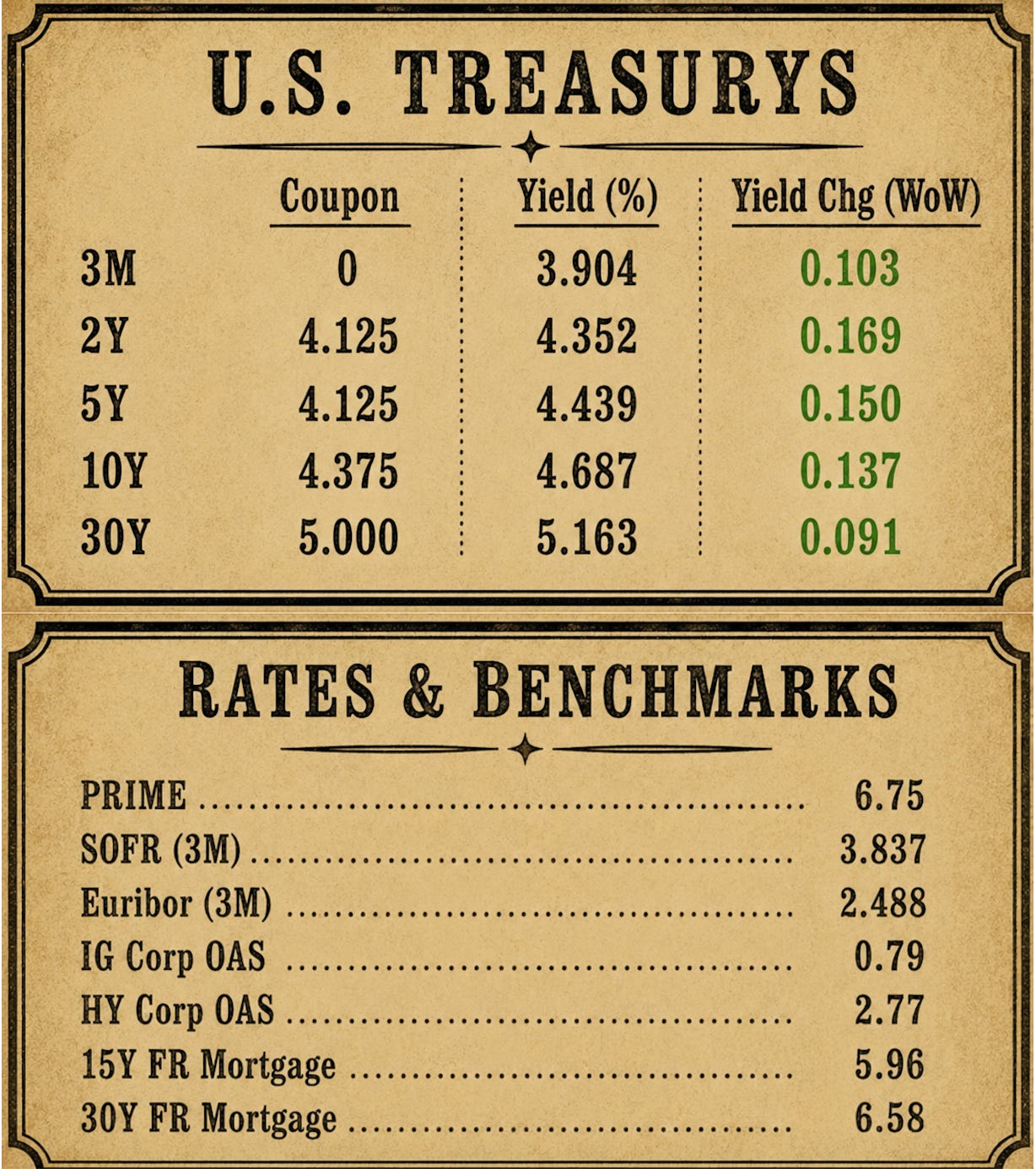
Chart of the Week
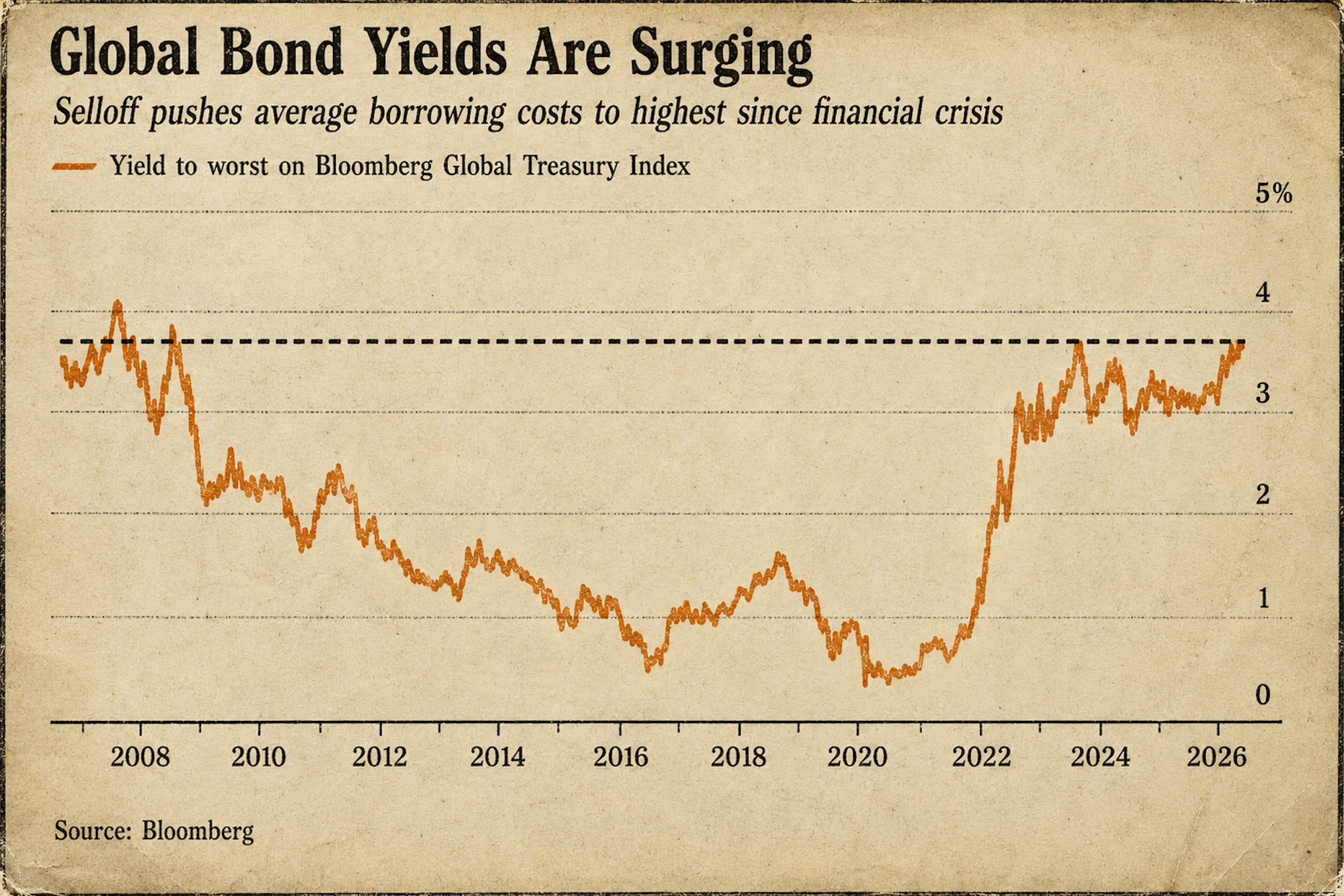
Global bonds were hit this week as energy prices surged again. UK gilt yields this week posted their longest run of daily closes above 5% in almost two decades, while Germany’s 10-year yield hit its highest level since 2011. The U.S. 30-year yield finished just shy of its highest level since 2007.
Bloomberg is offering 60% off its annual subscription ($180 vs $399) LINK
If you're not a subscriber and the article is behind a paywall, search for the article title online. It's often reprinted on Yahoo Finance for free.
WSJ Online is offering 65% off its annual subscription ($4 per week vs $11) LINK
These are NOT sponsored links, just money-saving tips.
Ignore the “Chart of the Week” if you wish. I happen to think it’s a bit concerning.